Benjamin Moulin, MD, last update octobre 2024

How to decrease prostate size in benign prostate hypertrophy?

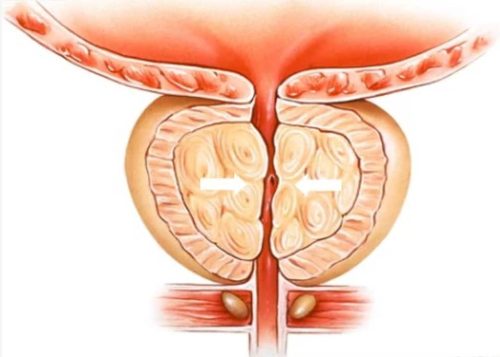
As men age, the volume of the prostate increases, causing it to become swollen, or enlarged. This increase in size, known in medical terminology as adenoma or benign prostatic hyperplasia (BPH), is responsible for urinary symptoms.

There are many treatments and lifestyle modifications that can help reduce prostate enlargement; we present the main ones.

With age, the prostate tends to become enlarged.

Prostate artery embolization: a minimally invasive treatment to decrease the size of prostate

→ A minimally invasive treatment for benign prostatic hypertrophy (BPH)

Prostate embolization is a minimally invasive procedure that involves blocking the arteries supplying the prostate using small beads, under local anesthesia. The operator inserts a catheter into an artery in the wrist or groin and then navigates to the pelvic arteries to block the prostatic arteries. During embolization, the entire procedure is performed through the vessels; there is no treatment through the penis: no endoscope, no urinary catheter. The patient can return home after a few hours of monitoring.

→ An effective treatment to decrease the size of the prostate

The results of embolization are excellent, with a significant improvement in urinary symptoms in 80 to 90% of cases. This improvement pertains to both the objective scores used to assess urinary disorders (IPSS score) and the patients’ perception of their symptoms. The majority of patients (over 90% in studies) are very satisfied with the procedure and would recommend it to a friend or choose embolization again if they had to do it over.

Some studies show an improvement in erectile dysfunction after embolization. This improvement is variable, and the mechanisms are not fully understood. Currently, there is no formal evidence regarding a potential effect of embolization on erectile dysfunction.

→ A treatment witch preserves sexual function: ejaculation and erection

Another advantage of this technique is the preservation of urinary and sexual functions, particularly ejaculation. There is never any urinary incontinence following an embolization. Moreover, the serious side effects of prostate embolization are practically nonexistent (read the article on the side effects and sexual effects of prostate embolization).

Prostate embolization, a minimally invasive treatment for an enlarged prostate

Benign prostate hypertrophy: what medications can be used?

There are several classes of medications to reduce the volume of the prostate. Two main classes of drugs are commonly used in practice: alpha-blockers and 5-alpha reductase inhibitors.

→Alpha-blockers: alfuzosin (UroxatralⓇ), Tamsulosin (FlomaxⓇ), Silodosin (RapafloⓇ), Doxazosin (Cardura

Ⓡ), Terazosin (HytrinⓇ)

Mechanism of action

Alpha-blockers are medications used to relax the muscles of the bladder, prostate, and urethra, thereby allowing for better urinary flow. Alpha-blockers block information received by receptors which control how often and hard the cells squeeze or tighten. By blocking them, these cells remain relax during urination, which improve urine flow.

→5-alpha reductase inhibitors: Finasteride (Chibro-ProscarⓇ), dutasteride (AvodartⓇ)

Mechanism of action

These medications prevent the conversion of testosterone into dihydrotestosterone, which is a hormone responsible, among other things, for the swelling of the prostate. 5-alpha reductase inhibitors allow for an average reduction of about 30% in prostate volume, but this reduction is generally gradual and may take up to 6 months to manifest.

Side effects and adverse effects

5-alpha reductase inhibitors are responsible for various common side effects (1 to 10% of cases), including decreased libido, impotence, ejaculation disorders, and increased breast volume.

More rarely, these medications can cause psychiatric disturbances, including anxiety states, mood changes, or depression. If there are mood changes, the medication should be discontinued, and a doctor should be consulted urgently.

→Anticholinergics: Oxybutynin (Ditropan®), Tolterodine (Detrusitol®), Ceris®, and Vesicare®.

Mechanism of action

These medications block the receptors of the detrusor muscle in the bladder. This inhibition of bladder muscle contraction does not directly affect the volume of the prostate but rather addresses the consequences at the bladder level: it prevents the repeated and sometimes involuntary contractions that can occur due to bladder irritation (overactive bladder) resulting from prostate swelling. This molecule also limits « urgency » (frequent urges to urinate) and the risk of developing a struggling bladder.

Side effects and adverse effects

Anticholinergics can have side effects due to their effects on the entire body. These effects are usually not serious but can be disabling in daily life. Some of the side effects include constipation, nausea, dry mouth, headaches, dizziness, drowsiness, and dry skin. Some precautions should also be taken regarding the risk of acute glaucoma and urinary blockage (urinary retention), which may require urgent medical consultation.

→Phosphodiesterase type 5 inhibitors: Cialis® (Tadalafil), Viagra® (Sildenafil), and Spedra® (Avanafil)

Mechanism of action

As their name suggests, these medications inhibit the action of phosphodiesterase type 5, which is an enzyme that terminates an erection.

Initially, these compounds were developed for the treatment of erectile dysfunction. However, they have also demonstrated efficacy in reducing prostate size. They are not commonly used as a first-line treatment for an enlarged prostate but may be interesting for patients experiencing both urinary and erectile difficulties.

Another important point is that these medications are not reimbursed by social security. Their cost is approximately €15 per month.

Side effects and adverse effects

Phosphodiesterase type 5 inhibitors can have serious side effects, particularly concerning cardiovascular health (myocardial infarction, sudden death). They require careful evaluation of the heart and blood vessels before prescription.

Benign prostate hypertrophy: natural treatment

→ Hygiene and Dietary Rules

Combating constipation, reducing alcohol and caffeine consumption can help decrease prostate size. Physical activity is also recommended. However, it’s important to note that prostate problems in men can sometimes be exacerbated by cycling.

→ Phytotherapy

Many plant extracts can influence prostate size. Notable examples include nettle roots, saw palmetto (Permixon®), epilobium, tomatoes, African plum (Tadenan®), green tea, pumpkin seeds, squash, pomegranate, cloves, and onions. Tadenan and Permixon are regulated medications with established development and dosing, which can serve as alternatives to conventional treatments for prostate enlargement. However, natural plant extracts like saw palmetto are considered over-the-counter products. Their characteristics are not necessarily regulated, and can vary from one brand to another, particularly in terms of active ingredient dosage. This lack of standardization makes scientific evaluation of the efficacy of these treatments challenging.

To date, no study has compared phytotherapy to prostate embolization.

Benign prostate hypertrophy: which exercises can help reduce prostate volume?

Physical activity as a preventive measure for prostate adenoma

Engaging in regular physical activity can help prevent the onset of prostate adenoma. Some specific exercises can also improve bladder control.

Kegel Exercises

Kegel exercises involve tightening the bladder muscles for about 5 seconds and then relaxing for about 20 seconds. It is recommended to perform three to five sets of ten repetitions each day.

Meditation and Relaxation

Practices like meditation and relaxation techniques can enhance bladder control. Stress is a significant factor in bladder activity, so techniques that help reduce stress can lead to better bladder management.

Yoga

Recent studies suggest that certain yoga postures may help reduce blood flow to the prostate, thereby decreasing its volume and alleviating symptoms associated with prostate swelling.

Benign prostate hypertrophy, surgical treatment

There are multiple surgical techniques for treating prostate adenoma, which can vary based on the size of the adenoma, the patient’s profile, and the practices of the surgical team. These techniques provide excellent results in alleviating urinary obstruction. However, they are not without side effects, particularly concerning sexual function (such as reduced ejaculation and altered orgasm perception) and urinary function (post-operative incontinence, which may be temporary).

1. Transurethral Resection of the Prostate (TURP)

  • Description: TURP is a natural route resection of the prostate performed under general anesthesia or spinal anesthesia. An endoscope is introduced through the penis, and small pieces of prostate tissue are resected and removed, which is why it is sometimes referred to as scraping or shaving. The removal of this tissue restores a passage for urine flow. At the end of the procedure, a urinary catheter is placed to prevent clotting (bleeding and clot formation in the bladder).
  • Side Effects: TURP often results in retrograde ejaculation, meaning there is no ejaculation during sexual orgasm. It can also lead to urinary incontinence, which is usually transient.

2. Adenomectomy via Open Surgery

  • Description: Adenomectomy is a treatment for large prostate adenomas, performed when the prostate volume exceeds 80 cc. The procedure involves removing the adenoma while preserving the peripheral part of the prostate (unlike radical prostatectomy, where the entire prostate is removed and is a treatment for prostate cancer rather than adenoma). Typically, the surgeon makes an incision of a few centimeters on the skin and accesses the prostate either directly or through the bladder. Given the risk of clotting due to post-operative bleeding, a urinary catheter is left in place, which is removed once the urine clears, usually within a few days.
  • Side Effects: Similar to TURP, this procedure may result in urinary incontinence, which is often temporary.

3. Holmium Laser Enucleation of the Prostate (HoLEP)

  • Description: HoLEP involves using a laser introduced endoscopically through the penis to remove the adenoma. The adenoma is fragmented and then removed via the natural routes. After the procedure, a urinary catheter is placed until the urine clears.
  • Benefits: Laser resection can treat adenomas of all sizes. However, it requires an experienced surgeon, as studies show a correlation between the practitioner’s experience and the outcomes.
  • Side Effects: Like other surgical methods, HoLEP can lead to loss of ejaculation and decreased perception of sexual orgasm. Post-operative urinary incontinence is possible but is often reversible.

Enlarged prostate: how to choose between different treatments?

As you may have noticed, there are many treatments for an enlarged prostate. Each treatment has its advantages in terms of results, but also potential side effects.

The choice of treatment should be made after discussing with the prescribing physician to find the most suitable treatment based on each patient’s profile, particularly considering their age and expectations regarding urinary and sexual function.

D’autres articles sont disponibles sur notre site pour vous informer sur l’adénome de prostate et les différentes techniques de traitement.

Localisation

Consultations/interventions

Hôpital Américain, 55 Bd du Château, 92200 Neuilly Sur Seine